

Heavier Felt Stronger
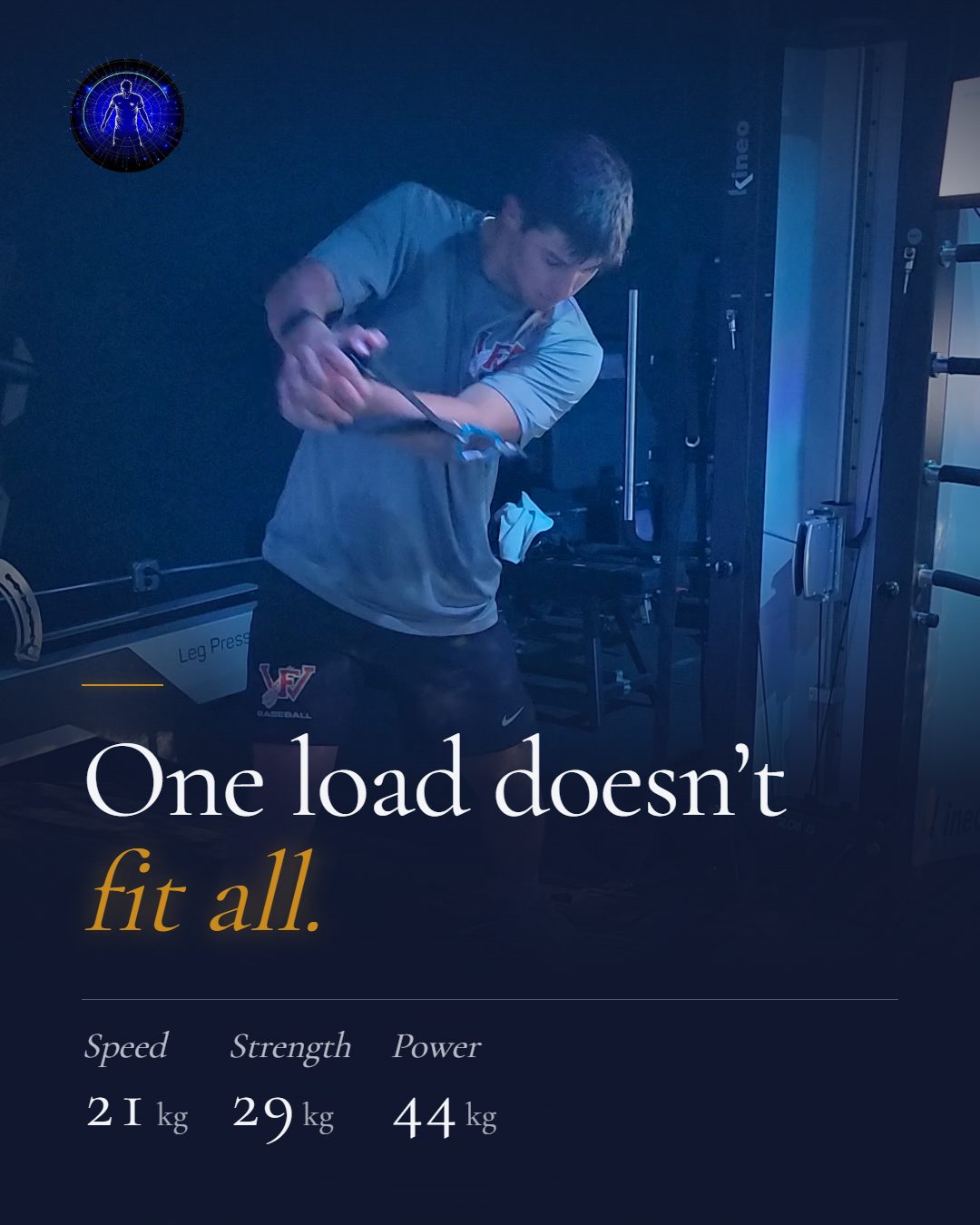
“Heavier felt stronger.” That is how a baseball player we work with described his resisted sprints. Every run felt right. The data saw more.
Most athletes judge a training load by how it feels. Heavier feels harder, harder feels like work, and work feels like progress. That story is coherent, and it is often partly true. But a coherent story can still leave something out. This post is about what the feeling left out, and why one load does not fit every goal.
Resisted sprint · Kineo power test
What he did
His session had three exercises: a rotational cable pull, a rotational swing and a resisted sprint of 12 to 15 feet with a belt attached to the Kineo. For the sprint we ran a power test. The machine added load on every run, from 5 kg up to 53 kg, and measured his speed and power on each one.
Before we looked at a single number, we asked him how it went. His answer was clear: the heavier runs felt stronger.
What the data showed
As the load climbed, two things happened at once.
- Speed fell. The heavier the belt, the slower he moved. That is expected. You cannot pull more and move just as fast.
- Power rose, then levelled off. Power is force and speed together. For a while the extra load added more than the lost speed took away, so power kept rising. Then it peaked, and more load stopped adding anything.
So his feeling was not wrong. The heavier runs really did ask more of him, and up to a point they really did produce more power. What the feeling could not tell him was where each quality lives, and when “heavier” stops helping.
One load doesn’t fit all
His speed and power curve gave us three different loads for three different jobs:
- Speed · 21 kgLight enough that he still moves close to his top speed
- Strength · 29 kgThe point where speed starts to drop and he has to push through the resistance
- Power · 44 kgWhere force and speed together reach their peak
Three loads. Three qualities. If he had trained every sprint at the load that felt strongest, he would have trained one quality and missed the other two. Picking the load by feel alone usually means picking one kind of training for everything.
These numbers belong to him, on this test, on this day. Another athlete will have a different curve, and so will he in a few months. That is the point: the right load is found, not assumed.
Your story first. Then the data.
We do not start with the machine. We start with the athlete. How did it feel? What did you notice? What do you think happened? Then we test that story against the data, and we look at what it confirms and what it leaves out.
Feelings are information, not a verdict. “Heavier felt stronger” told us something real about effort. The data told us something the feeling could not see. Neither one alone gave the full picture. Together they gave him a direction: which load to use, for which goal, and why.
After every session, four questions help athletes do this for themselves:
- What happened?
- Where is it leading?
- Why does it matter, to me and to others?
- What did I leave out?
For parents and coaches, the same habit applies. When a young athlete says “that felt great” or “that felt bad,” take it seriously, and then ask what the feeling might not show.
More information isn't the answer. Meaning is.
Milan Trajlov, Founder, Adaptiverse
Adaptiverse: from coherence to meaning. We start with the athlete's own story, test it against the data, and turn both into a direction.
Shared with the athlete's and his family's permission.
About Adaptiverse
Adaptiverse is an athlete development lab built on one idea: more information isn't the answer, meaning is.
For athletes: you tell your story first, through reflections after games and training. We then test it against objective data (force-plate testing, Kineo strength and power testing, and GPS match analysis) and turn both into a clear direction in your personal report.
For coaches, teams and organisations: the same approach helps leaders make sense of their work, communicate so it lands, and build the conditions their people need to grow.
Grounded in doctoral research.
