

Talent. Work. Realization. — What a Knee Injury Taught Us About the Full Picture
By Milan Trajlov | Adaptiverse
One of our athletes called me after the game. She had just sustained a knee injury. She was calm - more calm than most people would be - and the first thing she wanted to talk about was not the pain. It was the process. What happened. Why it happened. What she needed to understand before she came back. That conversation, and the data we reviewed together afterward, became one of the clearest demonstrations of the Adaptiverse methodology in practice - not because everything went right, but because every layer of what went wrong was visible, traceable, and instructive. What follows is that case, examined through the four-step process we use with every athlete: Capture, Expose, Realize, Navigate.
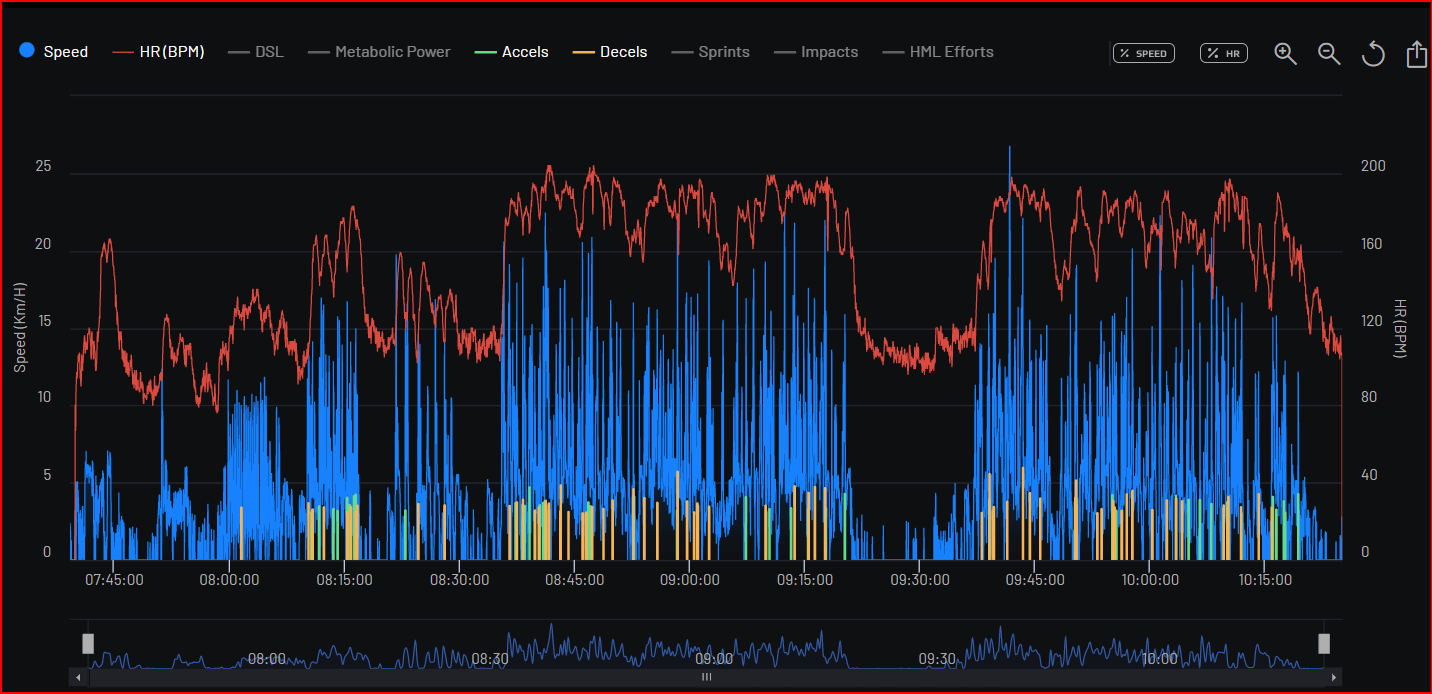
Game Report: Speed, HR, Acc, Dec.
Step 1 — Capture: What She Experienced
The Adaptiverse process always begins with the internal experience. Not the data. Not the external observation. What the athlete actually lived through. Before the game, she completed her first visualization session. For a first attempt, the quality was genuine. She had built specific scenarios grounded in our foundational playing principles — area of responsibility, defensive direct involvement, pressing triggers. One line stood out: "If their back is facing me, I press hard and don't let them turn." She also noted her warm-up had not felt right — better than before with this team, she wrote, but not what it needed to be. During the game she described feeling frustrated. Fouls were being called against her repeatedly. The opposition had scored three times from corners — the only goals in the game. Time was running out. The frustration was building. In her own words about the injury moment: "I knew there was limited time left, and I was already pretty frustrated and angry, and I saw the girl's back was to me and receiving the ball so I went." And immediately afterward: "My knee felt fine. I didn't feel weak." This is the capture: what she prepared, what she felt, what she experienced in the moment. It is the internal reality. It is where the work begins.
Step 2 — Expose: What the Data Showed
The Expose step places the internal experience beside the external reality. Not to contradict it — but to reveal what it could not see on its own.
The warm-up. She said it did not feel the best. The data showed what that meant precisely. Maximum speed in warm-up: 18 km/h, against her personal maximum of 26.5 km/h. Heart rate reached 155 BPM. Time spent in zone 4: 4 minutes and 18 seconds. She never reached zone 5 or zone 6. Her body entered the game without reaching the intensity thresholds that competitive match demands require. A body that never touches its upper zones in warm-up starts the game at a lower baseline — less neurologically activated, less physically primed, less resilient to ninety minutes of accumulated demand.
The game. Across the full match, her acceleration count was 30. Her deceleration count was 55. That asymmetry is significant: fifty-five decelerations against thirty accelerations means she spent considerably more of the game responding to the game than initiating within it. The body was already communicating a pattern - reactive rather than proactive, being acted upon more than acting. The three minutes before the injury. She covered 122 meters. Almost walking. Her maximum speed in that window was 15 km/h - 57% of her personal maximum. Her heart rate had dropped to 122 BPM. She felt fine. The data described a body that had been under-prepared from kick-off and was operating on diminishing reserves throughout.
This is the gap. Her internal experience said: I am ready, this is the right moment, I can make this press. Her external reality said: 122 meters in three minutes, heart rate dropping, maximum speed less than 60% of capacity, fifty-five decelerations already logged. Neither alone tells the complete story. Placed beside each other, they reveal what actually happened.
Step 3 — Realize: Naming What the Gap Reveals
The Realization step is where the work of naming begins. Not labeling. Not categorizing. Naming — with the precision that only comes when you have both realities in front of you simultaneously. There are three things the gap between her internal experience and the data reveals.
First: the warm-up failure was a continuous engagement failure. One of the foundational principles we teach is continuous engagement - the understanding that attacking and defending are not separate modes an athlete switches between, but a single continuous cycle: read, decide, act, read again. This cycle does not pause between phases. It does not reset after a defensive action. And critically - it does not begin at kick-off. It begins in warm-up. When continuous engagement is genuinely internalized, warm-up is not preparation before the game. It is the first act of the game. The body needs to reach the intensity zones that competition will demand, because competition has already begun in the mind. Her warm-up data - never reaching zone 5 or 6, maximum speed 18 km/h - tells us that the principle had not yet embedded deeply enough to govern how she approached the ninety minutes before the whistle.
Second: the visualization was a list of tasks, not a continuous film. Read her pre-game visualization carefully. Every line is a standalone trigger. If this, then that. Each response is complete in itself - and then stops. There is no continuation. No chain. A game never stops at the moment of action. If she wins that ball - then what? Where is she? What does the team shape require? What did she scan before she pressed -did she already know her options before she touched the ball?
On the attacking side the same question applies in the opposite direction. Before she receives: did she check her shoulders? What is the distance between her and the nearest opponent? Is there a supporting run? Where can she break the line? The decision she makes with the ball is shaped entirely by what she read before she touched it. This is not a failure for a first visualization session. A first session will naturally reflect what the athlete currently knows and currently focuses on. The defensive direct involvement principles are present - she has broken down the opponent-facing-back situation, she has thought about delay and pressure. What is not yet there is the connecting tissue: each action leading to the next situation, each situation requiring the next scan, each scan producing the next decision. Not tasks. Scenarios with continuations. Her visualization had prepared her to act in that moment. It had not yet built the next frame - what happens if the opponent turns.
Third: emotional activation broke the cycle entirely. She was frustrated. At the fouls, the corners, the time. That frustration is where emotional state becomes a physical preparation issue. Adaptiverse teaches athletes to listen to the body - to know they cannot sprint the full game, to know where they are in the cycle of effort and recovery. She knew the principle. But frustration creates interference. It narrows attention, activates the urgency system, and systematically reduces access to the very signals the body is sending. The louder the emotional noise, the quieter the physical signal becomes. At 122 meters in three minutes, at 57% of her maximum speed, with a dropping heart rate - her body was communicating clearly. The emotional activation had overridden the listening. The continuous engagement cycle had been replaced by urgency and reaction. The same principle that had worked earlier in the game - press when the back is facing - was applied in a context that could no longer safely support it. Balancing position relative to the game state is not only spatial. It is physiological. Where are you physically in this moment? What can your body actually support right now? Those questions require the read-decide-act-read cycle to be running. In that moment, it was not.
Step 4 — Navigate: What She Did, and What Comes Next
Within hours of the injury, she had written a detailed analysis of the game. She named her warm-up as insufficient. She identified the moment she had lost trust in her outside back and how that had cascaded into wider positional problems. She traced the communication failures with her defensive line. She described how the fouls had changed her physicality. She located the exact mechanism of the injury - tiredness, emotional activation, a body that had stopped being tense and ready without her noticing. She wrote: "After the discussion this morning, I also realized how I wasn't thinking about protecting myself because I hadn't gotten injured in a while so then my body wasn't ready for it which then made me weaker to getting injured." That is Realization. Not reflection — Realization. The capacity to name what you lived through with enough precision that the next decision can be different. She also described what she was already planning - visualization work to return without hyper-focusing on the knee, communication protocols to develop, trust in teammates understood as a tactical problem with a tactical solution. This is what of Realization work produces. Not an athlete who avoids adversity. An athlete who can think clearly inside it. The navigation for the next stage of her development is clear across all four layers.
Warm-up is no longer routine - it is the first data point of the game. The body needs to reach zone 5 and zone 6 before kick-off. That is the standard. If it does not, that is information about readiness, not a ritual completed. The visualization expands from isolated triggers to continuous chains. Each scenario runs forward: the press, the win, the transition, the scan, the pass, the next position. And it runs in both directions - before the press, the scan; before the receive, the shoulder check; after the defensive win, the first attacking decision. Both phases. One continuous film. Listening to the body becomes a mid-game feedback loop — not only a training principle. At key moments during the game: what is my body actually doing right now? What does my physical state tell me about what I can safely attempt? This is not a distraction from the game. It is part of reading the game accurately. And emotional regulation becomes a physical preparation skill. When frustration builds - when fouls accumulate, when the score is wrong, when time is running out — the question is not how to suppress the feeling. It is how to stay inside the read-decide-act-read cycle despite it. That is a trainable capacity. It develops with more games, more data, more scenarios to process, and more practice navigating the moments where external pressure tries to pull the athlete out of the cycle.
Why This Case Matters Beyond This Game
The most important thing about this story is not the injury. It is what she did with it.
The capacity she demonstrated — to name what happened with precision, to trace causes rather than assign blame, to identify what needs to change and how to change it — is exactly what we are building. And it does not stay on the pitch.
An athlete who learns to understand their own experience does not just perform better. They become someone who can navigate whatever comes next — in competition, in relationships, in the decisions that matter most. The continuous engagement cycle, the listening to the body, the capacity to read context and update decisions in real time these are not soccer skills. They are human skills. Sport is the arena in which we develop them. We use sport to develop people. Not just performers.
Adaptiverse works with athletes, coaches, and organizations in soccer and beyond. Based in Fallbrook, California. In-person and remote.adaptiverse.com
Note: Published with full consent of the athlete and her parent/guardian. Identifying details have been kept to a minimum to protect the athlete's privacy.
