

What 22 Days of Measurement Shows
We are now 22 days from the March 15 injury. Yesterday we completed the latest round of isometric knee testing. The trend data from March 19 through April 6 tells a story that a single assessment never could.
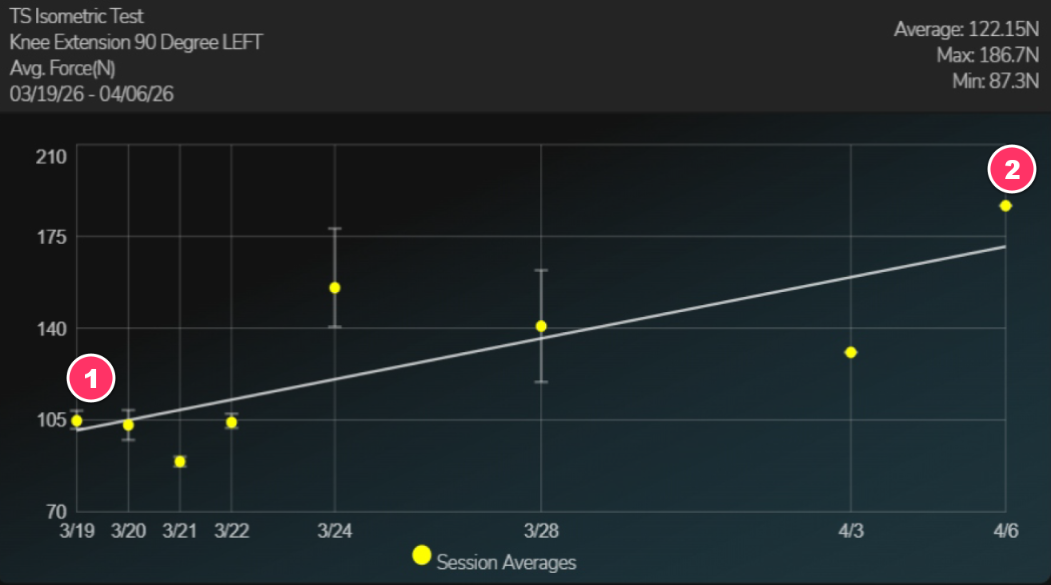
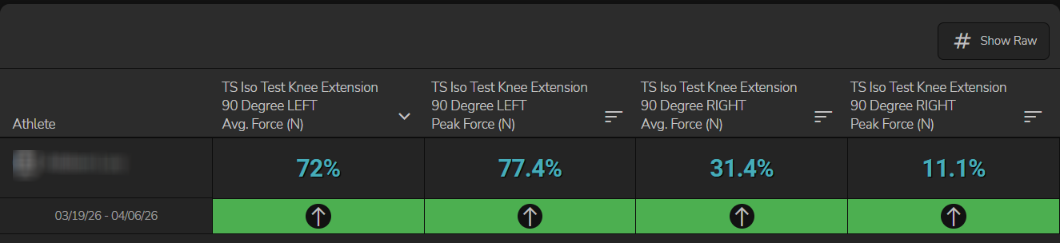
#1.After Injury and #2. 22 days later
Left knee — the injured side.
Knee Extension 90 Degree Average Force started at approximately 105N on March 19 — four days after the injury. By April 6 it had reached 187N. That is a 78% increase over 18 days of rehabilitation. Crucially, this is not a single spike — the trend line across the full session sequence is consistently upward.
Peak Force on the same movement: 120N → 245N. Total Impulse: 510 N.s → 934 N.s.
Knee Flexion Average Force followed the same trajectory: 131N → 224N.
Right knee — the uninjured side.
This is the detail that matters beyond the injury itself: the right knee is also improving significantly. Extension Average Force moved from 210N to 325N across the same period. Peak Force: 270N → 400N.
This is what a bilateral strength development program produces. The goal is not only to restore the injured side — it is to build the complete foundation that return to play requires. The right knee improving at this rate tells us the program is working systemically, not just reactively.
Knee Abduction and Adduction seated — both sides.
AB Seated and ADD Seated testing began March 22 and shows consistent upward trends bilaterally through April 6. The surrounding musculature — the full stability system around the knee — is building alongside the primary extension and flexion strength.
What this trajectory means.
A single post-injury assessment tells you where the athlete is. Twenty-two days of consecutive measurement tells you something more important: the rate and consistency of recovery. The trend line is not only positive — it is consistent. There are no sharp reversals. The body is responding to the rehabilitation load session by session, and the data is recording it.
Testing began four days post-injury. Every session since March 19 is on the record. The measurement infrastructure that was in place before the injury — that captured the baseline, that showed the asymmetry — is now the same infrastructure tracking the return.
This is the Navigate step in real time. Return to play is not defined by how she feels or by time elapsed. It is defined by the limb symmetry index approaching the clinical thresholds appropriate for her age, position, and playing demands. Each session builds the data trail that defines when that threshold is reached.
And alongside the data — the internal experience continues to be captured. How the knee feels in the session. What the movement feels like compared to last week. Where the body feels strong and where it still hesitates. The external measurement and the internal experience, placed beside each other, session by session, until the gap between them closes.
Adaptability begins with Realization.
